JustForex
Loading recent posts...

Dec 27, 2011

Asus Teases Lamborghini VX6S Cedar Trail Netbook in New Presentation Video


Asus has been showcasing the Lamborghini VX6S at various trade shows and event in the industry for almost six months now, but this Intel Cedar Trail powered netbook has yet to make its arrival until now.

However it now seems like we aren’t that far away from its launch, as in order to increase the hype surrounding its product Asus has now put together a new presentation video for the VX6S, which was spotted by Notebook Italia.

The video, which we enclosed right bellow this article for your viewing pleasure, focuses on showing the similarities between the VX6S and the Lamborghini LP700-4 Aventador supercar, its design is based upon.

Those of you familiar with the original VX6 won’t find that many differences between the two, since most of the changes brought to the Lamborghini VX6S concentrated more on the inside of the netbook.

One of these modifications is the inclusion of a new Atom Cedarview processor that is supposed to make the notebook more responsive and somewhat more powerful.

Just as with its previous model, Asus decided on using an Atom CPU that was designed for nettop use and settled with the D2700 that includes two processing cores with Hyper-Threading support running at a 2.13GHz clock speed.

Changes were also brought to the graphics used inside the system as Asus has decided to swap the ION GPU used before for an AMD Radeon HD 6470M, which includes 160 unfied shaders clocked at 700MHz.

The rest of the Lamborghini VX6S hardware specs include, 2GB of DDR3 memory (upgradeable to 4GB), a 500GB hard drive, Bluetooth and Wireless N connectivity, a card reader, and a built-in webcam.

The battery uses a 6-cell design (58Wh) and the 12.1-inch LED backlit screen sports a native resolution of 1366x768.

When it designed the Lamborghini VX6S, Asus also included a Bang & Olufsen ICEpower sound system, which should deliver high-quality audio.

Sadly, no information regarding pricing or availability was disclosed by the Taiwanese company, but we’ll keep you up to date with how things evolve from now on.


Gigabyte Motherboards Go Down in Smoke, Get Recalled


In a surprising, and somewhat disheartening, turn of events, Gigabyte has discovered that quite a few of its newest motherboards have a tendency to blow up.

Granted, 'blow up' may be a harsh term, since the issue is that a MOSFET or some other component can fry, and this applies to quite a few boards still in customers' possession.

The original sighting of what seems to be an engineering flaw happened when a Taiwanese overclocker did a mild overclocking experiment on the Gigabyte X79 UD3 motherboard.

"Bad luck" is what most people thought when they learned of the occurrence but, after that, Gigabyte received some more complaints which said that even moderate voltage-assisted CPU overclocking could fry the VRM.

The notices led to investigations and the company eventually found that the issue was more far-reaching than anyone believed.

Gigabyte also discovered that there was more than one problem at work.

The PWM circuitry used some bad quality components, something that bad firmware definitely didn't alleviate.

Gigabyte did provide a fast solution, a new BIOS in fact, but while it does more or less prevent this sort of burnout, it does so by eliminating the overclocking abilities of the motherboards altogether.

The boards in question are the GA-X79-UD3, GA-X79-UD5, and G1.Assassin 2, which enthusiasts bought largely because they could overclock things.

Once the new BIOS is installed, the CPU will be throttled when extreme stress is detected, so as to save the VRM.

Fortunately for enthusiasts, Gigabyte is also accepting faulty products back and offering replacements for free.

No new and fixed platforms are available now, though, but the GA-X79-UD3, GA-X79-UD5, and G1.Assassin 2 have been taken off store from shelves as well, so whenever they start selling again is when replacements will be shipped to affected customers.


Samsung Reconsidering Android 4.0 Upgrades for Galaxy S and Galaxy Tab


A few days ago, Samsung had no plans for delivering the new Android 4.0 Ice Cream Sandwich operating system to the owners of a Galaxy S or Galaxy Tab device, but things might have changed recently. 

New reports on the matter suggest that the company is currently reconsidering its position towards these updates. 

Soon after having announced that it would not provide users of Galaxy S and Galaxy Tab devices with the Android 4.0 Ice Cream Sandwich OS due to a series of hardware limitations, the company started to receive a lot of negative feedback from users. 

As one can easily imagine, people were irritated by the announcement, since Samsung was actually expected to provide them with the update without a fuss. 

The South Korean handset vendor claims that these devices do not sport enough internal memory to accommodate the latest Android release from Google, but users beg to differ. 

As a result, the vendor decided to take a closer look into the matter, so as to determine whether there is a way in which Ice Cream Sandwich could work on Galaxy S and Galaxy Tab. 

After all, some unofficial ROMs for Galaxy S were already spotted into the wild, offering users the possibility to upgrade their devices. 

Chances are that Samsung will deliver the Android 4.0 upgrade to users, but that it will remove some elements from its TouchWiz interface, which is most probably the reason why said devices lack the necessary memory amount required for the upgrade. 

Nothing has been officially unveiled on the matter as of yet but, if things are indeed so, it should not be too long before the handset vendor makes a formal announcement. 

After all, the Galaxy S was the first successful handset in the series, with millions of units sold in a rather short period of time, and Samsung should rewards its users by delivering the Ice Cream Sandwich platform to their devices as well.


Face Unlock Available for Nexus S via Custom Android 4.0 ROM


A few weeks ago, Google started to deliver the Android 4.0 Ice Cream Sandwich operating system to Nexus S devices out there, though some of the features that made it to Galaxy Nexus were not available for the older handset, such as Face Unlock. 

The said software update created a lot of problems, and even bricked some Nexus S handsets out there, which even determined Google to put an end to its roll-out. 

Issues such as connectivity problems, battery drain, reboots, inability to access various functions of the device and the like have been reported by those who installed the new update, yet there are also some who managed to install the software successfully and issues free. 

While most of the phone’s capabilities are put to good use in Android 4.0 Ice Cream Sandwich, there are also those who are left aside. Such is the face unlock feature in ICS, which takes advantage of the handset’s front camera. 

A custom ROM is now available for them, based on the Android 4.0.3 OS, and meant to bring the said capability to both Nexus S 4G at Sprint, as well as to GSM Nexus S smartphones out there. 

The downside, however, is that users will have to root their devices to install the ROM. They will also have to wipe the handset clean, it appears. 

The said ROM emerged over at the Android Forums as AOSP 4.0.3 and brings along a series of other tweaks as well, it seems. Those interested in learning more about it should head to this thread on the said forums if they own a GSM Nexus S, or to this post if they own a Nexus S 4G on Sprint’s CDMA network. 

Just keep in mind that this is an unofficial ROM, and that you will have to tinker with your handset to install it. Hopefully, an official update to add the face unlock functionality to Nexus S will also be delivered soon, so stay tuned.


Nokia 801T Lands in China with Symbian, TD-SCDMA Connectivity


Finnish mobile phone maker Nokia plans on increasing its presence on the market in China, and the company has just announced a new Symbian smartphone for this market, namely the Nokia 801T. 

The new device is running under the Symbian operating system, and is set to land on shelves in China with support for the local TD-SCDMA networks. 

Apparently, Nokia designed it with the Symbian^3 operating system inside, as well as with a series of features and capabilities tailored for the Chinese market. 

The new mobile phone arrives on shelves with a large 4-inch touchscreen panel, which should offer a great experience when it comes to displaying messages, information, and photo content. 

Additionally, it comes with a built-in telescopic TV antenna, which is meant to provide users with instant access to mobile TV (CMMB) regardless of the place they are in.

Not to mention that the new Nokia smartphone offers users the possibility to connect to the fast TD-SCDMA networks in the country. 

It also packs NFC functionality for delivering increased convenience and functionality through simply touching NFC-enabled mobile phones and accessories to match.

The handset features an all-metal unibody, but little is known at the moment about the rest of its hardware specifications. 

What we know is that the new device will be launched on shelves at China Mobile, and should offer support for a variety of applications, Nokia explains. 

Users can download and install applications on this device to benefit from a better experience, while also enjoying its web browsing capabilities, as well as a variety of services that have been made available for it. 

Unfortunately, it’s still not clear exactly when the smartphone will be launched at the wireless carrier. However, since it has already made the phone official, Nokia might be set to make it available in the not too distant future, so stay tuned for more on this.

Nokia 801T


Dec 26, 2011

Nokia Lumia 800 Spotted at the FCC, Torn to Pieces


Finnish mobile phone maker Nokia is gearing up for pushing the recently launched Lumia 800 smartphone to more markets than those which got a taste of it back in November. Thus, the company got the handset through FCC testing, and the results already came out. 

The Windows Phone device has been torn to pieces by the Federal Communication Commission, and all of its internals brought to light for us to have a look at. 

The mobile phone has just received the necessary approvals from the feds, though this does not confirm a near release in the United States. 

However, it does bring it closer to the North American market, which certainly sounds great for enthusiasts. 

The FCC also unveiled the user manual for Nokia’s Lumia 800, along with the aforementioned photos with its internals.

These documents show that Lumia 800 might arrive on shelves with support for 850 and 1900MHz 3G bands, which would make it compatible with the airwaves of AT&T. 

Some of the previous rumors on this device suggested that the wireless carrier might indeed launch a Nokia Lumia smartphone in the first quarter of the next year, and that LTE connectivity might also be included. 

In January, T-Mobile’s customers will be able to purchase another Windows Phone from Nokia, namely the Lumia 710, a move made official only recently. 

Nokia has yet to announce any plans for bringing the Lumia 800 smartphone to the US market, though it might not be too long before that happens, provided that previous rumors will pan out. 

Specs wise, we might expect Nokia Lumia 800 to arrive in the United States with the same capabilities as the international device, including the 3.7-inch touchscreen display, or the 1.4GHz application processor. 

The smartphone also includes 16GB of internal memory, along with an 8-megpixel photo snapper on the back, with support for HD video recording.


Unannounced Nokia Phone Spotted in Microsoft Video Ad


Windows Phone comes with a series of integrated Microsoft services, and making use of them is easy. 

The Redmond-based software giant seems determined to underline that as often as it can, and has put up a video to show how Windows Live can be easily accessed straight from a Windows Phone. 

The demo, however, is made on a Nokia device that apparently differs from the Lumia 800 and Lumia 710 devices that have been already released. 

No specific info on what this device would be emerged, but some suggest that it might actually be the Lumia 900 that has been long rumored before. 

You can see specific Nokia apps listed on the device at a specific point in the video embedded above, clearly showing a handset from the Finnish company. 

A glimpse at the phone's back shows similarities with Lumia 800, further suggesting that Nokia's upcoming phone was featured in this ad, though no confirmation on this has emerged so far.

Intel Medfield SoC Includes Special Hardware Tweaks for the Android OS


Intel’s collaboration with Google seems to have led to more than just an x86 port of the Android operating system, as the chip maker has recently confirmed that its upcoming Medfield SoC will include a series of hardware optimizations specifically designed for this mobile OS.

In a meeting with the Technology Review website, where Intel has presented to the publication a Medfield-running tablet and smartphone, the chip maker also talked a little bit about the SoC’s Android optimizations.

The most important of these cover Web browsing and a series of Android apps, but some dedicated imaging processing circuits were also thrown into the mix.

These come in part from a Dutch image-processing company called Silicon Hive, which Intel has acquired earlier this year, and are paired together with some dedicated software tweaks.

The end result, as Technology Review reports, is a camera that can capture 10 full-size eight-megapixel images at a rate of 15 per second, as proved by the Medfield reference smartphone demoed by Intel.

Needless to say, this kind of hardware could come as a great help to augmented reality apps and other similar software.

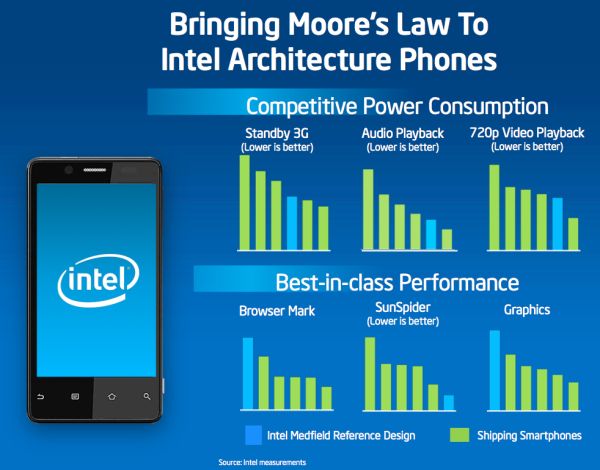
Medfield is a major step forward in the mobile space for Intel as this will become the company’s first single piece of silicon to incorporate all the hardware logic that is found inside the CPU and chipset of a traditional computer. 

As far as its performance is concerned, Medfield seems to be able to hold its own against many of the ARM-based SoC used in today’s smartphones, both in terms of power consumption and speed. 

Intel is expected to bring quite a few devices running the Medfield SoC at the upcoming CES 2012 fair, some of which will announced in the first half of 2012.


Nokia Lumia 800 Battery Update to Arrive on January 18th


Finnish mobile phone maker Nokia is gearing up for the release of a software update for its Lumia 800 devices to fix a series of issues with the model's battery, and it appears that it will push it out on January 18th. 

The company already confirmed plans to deliver the software update to its users, but did not offer specific info on when that might happen until now. 

However, a recent post on plaffo suggests that Nokia has already started to inform users on the availability of this update starting with the said date. 

This means that Nokia Lumia 800 users will still have to wait for about four more weeks before being able to benefit from the said enhancement. Even so, the good news is that it is coming, and that it will deliver the battery performance enhancements that users are waiting for.


Android Is Finally Coming Back to Linux Kernel


Tim Bird in collaboration with many Linaro and individual developers, including Linux kernel maintainer Greg Kroah-Hartman, announced the beginning of the Android Mainlining Project, to include Android's patches and features into the mainline Linux kernel. 

As many of you know, the Android drivers were no longer accepted in the mainline Linux kernel, starting with Linux kernel 2.6.33, as announced by Greg Kroah-Hartman back in spring 2010.

However, it appears that Greg Kroah-Hartman himself will include the Android drivers into his development branch for the upcoming Linux kernel 3.3, making it boot on Android devices without being patched.

"At the recent kernel summit in Prague, there was a discussion about re-evaluating some of the Android-specific features that are found in Google's android kernel, and looking at whether and how to incorporate them into the mainline (kernel.org) kernel."- said Tim Bird, Architecture Group Chair, CE Workgroup of the Linux Foundation and Senior Staff Engineer at Sony Network Entertainment, in the email.

For more information or if you want to join this effort, please visit the wiki page or follow the discussions on the designated mailing list.


Twitter Delicious Facebook Digg Stumbleupon Favorites More

 
Design by Free WordPress Themes | Bloggerized by Lasantha - Premium Blogger Themes | coupon codes
`