JustForex
Loading recent posts...

Feb 28, 2012

Elpida Files for Bankruptcy As It Fails to Get Government Protection


Elpida tried to negotiate with the Japanese government, hoping to be granted protection to repay the $5.6 billion debt, but it had to file for bankruptcy instead. 

Elpida is Japan's only maker of dynamic random access memory (DRAM) and used to be one of the most powerful memory players in the world. 

Now, though, after misfortunes and poor marketing performance, it is in a very difficult financial situation. 

With a debt of $5.6 billion (4.16 billion Euro), it tried to get protection from the Japanese government. 

When that failed, it took the next logical measure: it filed for the beginning of corporate reorganization proceedings. 

“Since Elpida is Japan's only DRAM manufacturer many industry watchers and participants expected Japan's government to keep the company afloat out of national pride. This seems not to be the case,” reads an e-mailed statement from Objective Analysis semiconductor market research firm. 

In other words, it has filed for bankruptcy, much like Kodak did after it backed out of the camera market it used to dominate. 

“Elpida, while strong technically, has suffered because of the 2011 DRAM price collapse and Japan's strong yen. An export driven economy has to keep its currency undervalued to remain competitive in the world economy. The success of the Japanese economy raised the value of the yen. Elpida has good technology, but is simply unable to compete in an oversupplied world market using prices that are yen-based,” the statement reads. 

“Elpida will stay in business as various options are decided. The purpose of the bankruptcy is to shield the company from actions its creditors could legally take to seize assets. The intent is to continue to operate. This means that there will be no change to the current oversupply until a decision has been made.” 

If Elpida ends up selling any or all of its assets, Micron will probably be the buyer, since Hynix and Samsung have their own production to worry about and aren't in very safe waters either. We may even hear of business mergers in Taiwan down the line, where the majority of memory firms are stationed.


14-Nm Intel Smartphone CPU Set for 2014


If people thought Medfield was an improvement compared to what Intel previously tried to charm smartphone makers with, the future chips are sure to impress. 

Word just came out that Intel means to introduced 14nm mobile processors by 2014. 

This means that it wants to move faster than Moore's Law, which stipulates that the number of transistors that can be placed inside an integrated circuit, without increasing costs, doubles every two years. 

Intel's reported reason for speeding up is that the mobile segment progresses faster than the desktop/notebook market. 

We have recently seen that the existing Medfield, as well as some future chips, have been adopted by Orange and others. 

The Santa Clara company hopes to score even bigger with the 22nm units, set for 2013. 

As such, by the time 14nm chips are ready, Intel will have secured its spot in the tablet and phone industry, assuming ARM doesn't pull out some sort of hidden ace.


MWC 2012: LG Optimus 3D Max Hands-On


LG has unveiled some highly appealing Android-based smartphones before this year’s Mobile World Congress in Barcelona, including a successor to its first 3D-capable device. 

The company also chose to bring the new LG Optimus 3D Max handset to the event, so that people could have a better look at it. We seized the opportunity and played with the new smartphone. 

LG claims that this is the slimmest and brightest 3D-capable smartphone in the world. Clearly, it fits great in the hand, even if it packs a large 4.3-inch touchscreen display. 

Images on the screen are clear and sharp, due to its 480 x 800-pixel resolution (there was room for more, that’s for sure). And there is also the Corning Gorilla Glass 2 coating to protect the panel from scratches. 

LG Optimus 3D Max is powered by a TI OMAP 4430 dual-core 1.2 GHz Cortex-A9 application processor, featuring PowerVR SGX540 graphics and complemented by 1 GB of RAM. 

The new device also includes 8 GB of internal memory, but users can easily expand it through the featured microSD memory card slot with support for up to 32 GB of additional storage space. 

Connectivity-wise, the phone sports HSDPA, 21 Mbps; HSUPA, 5.76 Mbps, Wi-Fi 802.11 b/g/n and Wi-Fi hotspot, microUSB (MHL) v2.0, Bluetooth, DLNA, NFC, and built-in GPS receiver. 

To enable the much-praised 3D capabilities, LG packed the new handset with dual 5-megapixel photo snappers on the back, with auto focus and LED flash. It can shoot full HD videos in 2D, and 720p videos when in 3D mode. There is also a front camera to enable video calling. 

LG Optimus 3D Max runs under Google’s Android 4.0 Ice Cream Sandwich operating system with the LG 3D UI on top. It will arrive on shelves with support for Google Search, Maps, Gmail, YouTube, Google Talk, and the like. 

The smartphone measures 126.8 x 67.4 x 9.6 mm and weighs 148 grams. It is powered by a Li-Ion 1520 mAh battery. According to LG, the handset should arrive on shelves sometime in the second quarter of the year.


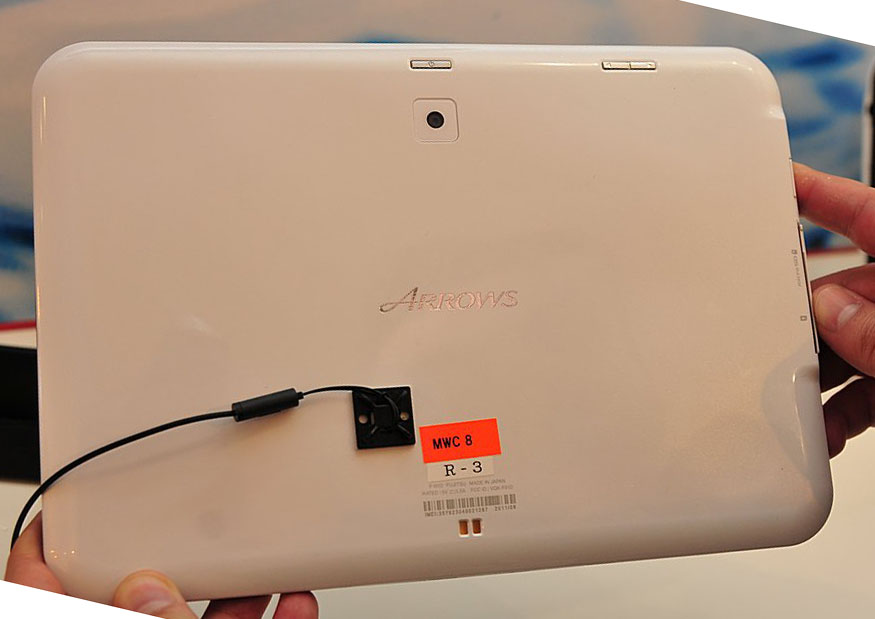
MWC 2012: Waterproof Fujitsu Arrows Tablet Close-Up


Fujitsu has brought a somewhat unusual tablet to this year's edition of the Mobile World Congress (MWC 2012) taking place in Barcelona, Spain. 

Where it is showing off the Arrows smartphone (which we filmed shrugging off clobbering from metal balls here), Fujitsu also has the Arrows tablet on display. 

Even from a cursory glance, one can tell this is not just any slate: the membrane surrounding its edges clearly show something is different, compared to the likes of Samsung's Galaxy Tab 2 (10.1), Galaxy Note 10.1 or Huawei's MediaPad 10 FHD. 

Basically, the Fujitsu Arrows tablet is waterproof (IPX5-7), so that owners may take it with them to the kitchen, to use as web assistant while cooking and throwing steam everywhere, for example. 

The company also assures us that the bathroom is no longer off-limits either. Even water submersion should easily be survived. 

The one feature that may be somewhat underwhelming is the operating system: Android 3.2 (Honeycomb) instead of 4.0 (Ice Cream Sandwich). 

The hardware is quite decent, though, even if Fujitsu chose not to use NVIDIA's Tegra platform. 

Instead, the Texas Instruments OMAP4430 dual-core CPU is present, with its clock speed of 1 GHz. 

16 GB of built-in NAND Flash storage are available, as is 1 GB of RAM (random access memory) and a microSD card slot (up to an extra 32GB). 

Now we reach the interesting part: in addition to Bluetooth 2.1+EDR wireless support and Wi-Fi, Fujitsu also implemented 2 GHz LTE. 

The UMTS frequency band support is of 2 GHz / 800 MHz, while the GSM frequencies are 850 MHz, 900 MHz, 1,800 MHz and 1,900 MHz. 

Finally, the 10.1-inch display features a native resolution of 1,280 x 800 pixels, plus capacitive multi-touch support. 

As for video chatting or taking photos and videos, the company added a 1.2-megapixel webcam on the front and a 5.1-megapixel camera on the back.


MWC 2012: Nokia 808 PureView Video Demo


On Monday, Nokia launched the most advanced camera phone in the world, the Nokia 808 PureView. 

Running under Nokia Belle, the new mobile phone packs a 41-megapixel photo snapper on the back, the highest-quality camera sensor in a smartphone. It can record 1080p Full HD videos and shoot great photos. 

The handset also comes with a 4-inch touchscreen display with Corning Gorilla Glass, as well as with a 1.3GHz ARM 11 application processor inside. It also comes with 16 GB of internal memory.

The main selling point of the new device remains the PureView Pro imaging technology that Nokia packed it with, along with the Nokia Rich Recording features. 

As you can see in the video we got the change to shoot at the MWC 2012 show in Barcelona, Nokia 808 PureView’s imaging capabilities are indeed impressive. Close-ups with the device are available below.

MWC 2012: Photos and Video of Nokia’s Lumia 610


Nokia Lumia 610 is the cheapest Windows Phone that Nokia unveiled to date. Launched on Monday at the Mobile World Congress, the handset is expected to arrive on shelves in the second quarter of the year with a price tag of EUR189 attached to it. 

Nokia’s Lumia 610 smartphone will be among the first devices in the world to arrive on shelves with the new Windows Phone Tango platform on board (the OS will be released in April). 

The smartphone packs a 3.7-inch WVGA TFT LCD touchscreen, an 800MHz application processor, 256MB of RAM, 8GB of storage, and a 5-megapixel photo snapper with auto-focus and a LED flash.

Nokia Lumia 610 will arrive on shelves with a variety of connectivity capabilities too, while being powered by a 1300mAh battery. 

You can admire the smartphone both through the video embedded above, as well as via the photo gallery below.

MWC 2012: Sony’s Xperia P in Red


Sony brought two new smartphones at the Mobile World Congress in Barcelona, Spain, one of which was the Sony Xperia P. 

We had the chance to play with the device at the official launch on Sunday, but also took the time to have a better look at it after the show kicked off. 

Sony announced the handset in three color flavors, namely Silver, Red and Black, and you can now get a glimpse of the red flavor in the photos embedded below. 

You can also have a look at the video presentation above to learn more on the special features the new device will arrive on shelves with. 

Featuring a design specific to Sony’s new Xperia NXT series, the handset should land on the market in the coming months with Android 2.3 on board and with a 1GHz dual-core CPU.

MWC 2012: LG Optimus 4X HD Hands-On


LG has brought to the Mobile World Congress in Barcelona all of the handsets that it made official during the past few weeks. 

Among them, there was the LG Optimus 4X HD, the first quad-core smartphone from the company, launched with the latest Android operating system on board. We had the chance to spend a few moments with it, and we shot a few photos for your viewing pleasure. 

The new mobile phone arrives on shelves with an Nvidia Tegra 3 Quad-core 1.5 GHz Cortex-A9 application processor inside, also featuring ULP GeForce GPU. 

Moreover, the new device arrives on the market with a 4.7-inch HD-IPS LCD capacitive touchscreen display capable of delivering a 720 x 1280-pixel resolution and support for 16M colors. 

The South Korean mobile phone maker claims that the new handset is capable of offering best clarity and color reproduction. Moreover, the device can deliver optimized battery consumption. 

LG has packed the new device with 1GB of RAM and 16GB of internal memory, but did not offer info on whether it would be expandable or not. 

On the back, the new device features an 8-megapixel photo snapper with auto focus and LED flash, capable of recording videos in full HD. The phone also packs a 1.3 MP camera on the front, great for making video calls. 

LG Optimus 4X HD was unveiled with HSDPA, 21 Mbps and HSUPA, 5.76 Mbps connectivity, as well as with Wi-Fi 802.11 b/g/n, Bluetooth, DLNA, Wi-Fi hotspot and microUSB (MHL) v2.0. 

It is powered by a Li-Ion 2150 mAh battery, features A-GPS support, TV-out (via MHL A/V link), 3.5mm headphone jack, and loudspeaker. The handset is only 8.9 mm thick.

LG announced the new Optimus 4X HD with Google’s Android 4.0 Ice Cream Sandwich on board, which also means support for all compatible applications and services. 

The South Korean mobile phone maker confirmed that the smartphone would be released in the coming months. Most probably, it will be put up for sale sometime in the second quarter of the year.


AMD FX-8120 and FX-6100 CPUs Get Cheaper, New Ones Debut


Advanced Micro Devices may not have anything to show at the Mobile World Congress, but that doesn't mean it is going to stay silent during the February 27-March 1 period (2012). 

The Tech Report has some interesting bits of information to share about the FX line of CPUs from Advanced Micro Devices. 

Not only are some new models appearing, but existing ones are getting a price cut. 

The two chips that will cost a bit less from now on are the FX-8120 and FX-6100. 

The former used to sell for $205 / 152.50 Euro, but should now be found for $185 / 137.62 Euro. 

The latter now costs $145 / 107.87 Euro, where it used to require a payment of $155 / 115.31 Euro. 

Moving on, the two new processors, which have not actually been formally launched yet, are the FX-6200 and FX-4170. 

FX-6200 is a six-core chip with a clock speed of 2.8 GHz, a Turbo Boost maximum limit of 4.1 GHz and a L2 cache memory of 6MB. Its TDP (thermal design power) is of 125W and the L3 cache memory is of 8 MB. 

Furthermore, the FX-4170 has the same TDP and L3 cache as above, but only 4MB of L2 cache and a frequency of 4.2 GHz / 4.3 GHz in Turbo Boost. It is a quad-core, hence the higher speeds. 

Both newcomers have a maximum DDR3 speed of 1,866 MHz and are constructed on the 32nm process technology. Finally, like their brethren, they are compatible with the AM3+ socket. 

We cannot tell for sure when the hexa-core FX-6200 and quad-core FX-4170 AM3+ will be available for order. 

At least there seem to be some pre-order prices for them: 152.70 Euro for the six-core and 120.60 Euro for the four-core. According to exchange rates, that means $205.25 and $162.11, respectively.


MWC 2012: LG Optimus L7 Hands-On


This year, LG launched a new smartphone series, the L-Style family of devices, which includes three smartphones at the moment. Among them, we can count the LG Optimus L7, which was present in LG’s booth at the MWC show in Barcelona. 

It is the better spec’d handset in the series, featuring a 4.3-inch screen and a TI OMAP 4430 dual-core 1GHz application processor, along with 1 GB of RAM. 

The phone was unveiled with HSDPA, 21 Mbps; HSUPA, 5.76 Mbps, WiFi, Bluetooth, Wi-Fi hotspot, microUSB v2.0 connectivity options, A-GPS support, and an 8.7mm thin body, with a metallic finish. 

LG Optimus L7 will hit the market with a 5-megapixel photo snapper with LED flash, a secondary camera for video calling, and Google’s Android 4.0 Ice Cream Sandwich platform on board. 

LG has yet to confirm the full specs list for this device. Until that happens, have a look at the live photos of the device that we took at the MWC 2012 show in Barcelona.


Twitter Delicious Facebook Digg Stumbleupon Favorites More

 
Design by Free WordPress Themes | Bloggerized by Lasantha - Premium Blogger Themes | coupon codes
`