JustForex
Loading recent posts...

Mar 7, 2012

CeBIT 2012: Gigabyte G1.Sniper 3 Intel Z77 Motherboard Makes Its Appearance


Even though barely a year has passed since the introduction of the original G1.Sniper, Gigabyte has recently unveiled the third iteration of this motherboard which is based on Intel’s upcoming Z77 Express chipset.

This G1.Sniper 3 seems to be Gigabyte’s most advanced solution for LGA 1155 processors, and so far it’s the only Z77-based motherboard we have seen to support 4-way CrossFire/SLI configurations.

This is made possible thanks to the integration of a PLX PEX 8747 bridge chip, which takes the 16 PCI Express lanes available in Intel’s third generation Core processors and splits them into four PCIe x8 links. This chip is housed right under the middle motherboard heatsink.  

Besides the four PCI Express x16 slots, the G1.Sniper 3 also includes a pair of PCIe x1 slots, a 32-bit legacy PCI slot, as well as a mSATA 6Gbps slot.

Additional storage devices can be attached to the board using the six SATA 6Gbps ports available (two driven by Intel’s Z77 PCH) or the remaining four SATA 3Gbps ports.

Like all the other G1-Series solutions before it, the G1.Sniper 3 also packs an on-board Bigfoot Killer E2100 network controller and Creative audio.

This time however, Creative X-Fi sound chip was replaced with a more powerful Sound Core3D implementation also featuring better ground-isolated amp circuitry.

Moving to the rear of the board, we get to see that Gigabyte has included all the connectors that one would expect to see in such a high-end motherboard, like six USB 3.0 ports, dual Gigabit Ethernet, as well as D-Sub, DVI, HDMI and DisplayPort video outputs. 

According to TechPowerUp, power to the installed CPU is delivered via a 15-phase VRM. No details regarding the release date or the pricing of the G1.Sniper 3 motherboard are available at this point in time.


Intel Core i7-3770 Preview: On-Board GPU Outperforms AMD & Nvidia Low-End Cards


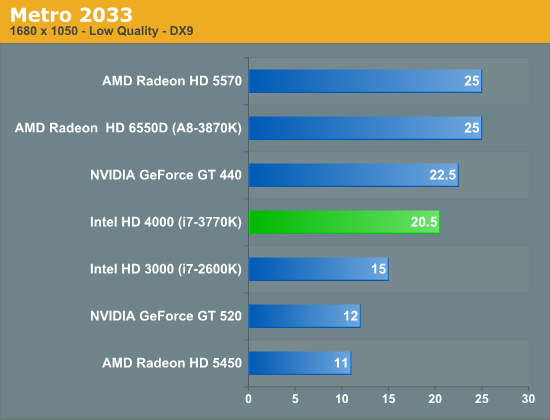
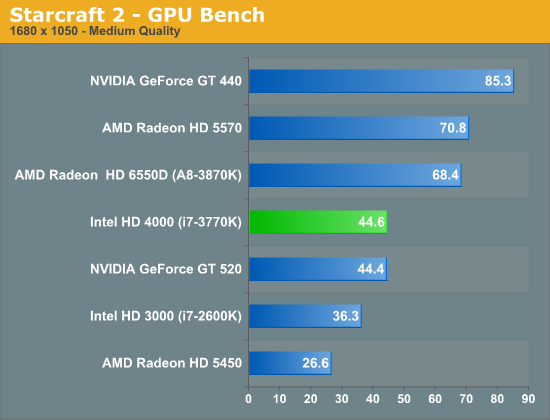
Even though Intel’s 22nm Ivy Bridge processors aren’t expected to be officially released until the end of April 2012, a preview of the Core i7-3770K CPU was recently posted online detailing, among others, the graphics performance of the chip when compared with AMD and Nvidia entry-level GPUs.

The Core i7-3770K preview was published earlier today by AnandTech, one of the most well-known and trusted hardware review websites out there.

From what we can tell, the CPU used for these tests is a “production quality Ivy Bridge” processor, but both the motherboard and graphics drivers used are still in a pre-production form.

What this means is that Intel could still improve the graphics performance of Ivy Bridge through a series of driver updates.

Despite the still early nature of these drivers however, the Intel HD 4000 GPU integrated in the Core i7-3770K processor proves itself to be quite capable of running some current games at 1680x1050 resolutions.

Furthermore, the HD 4000 even manages to significantly surpass entry-level graphics cards like AMD’s Radeon HD 5450 or Nvidia’s GeForce GT 520M, which in Metro 2033 is just 10% slower than the GeForce GT 440.

The Core i7-3770K is Intel’s highest performing desktop processor based on the Ivy Bridge architecture and it packs four processing cores with Hyper-Threading support clocked at 3.5GHz (up to 3.9GHz in Turbo Boost mode).

Much like the current Sandy Bridge-based Core i7 parts, the chip also sports 8MB of shared L3 cache, but its integrated GPU has been updated to the new HD 4000, which packs 30% more EUs than its predecessor.

So far, Intel hasn’t confirmed the official launch date of the Ivy Bridge processors, but the latest reports to arrive seem to indicate the chips will see the light of day at the end of April 2012.


Sony Xperia S Officially Introduced in Singapore for $710 USD (540 EUR)


Sony already introduced the Xperia S in several European and Asian countries, but the smartphone’s availability is still limited. 

Today, Sony announced the immediate availability of Xperia S in Singapore. Customers who want to purchase the device can do so for $898 SGD (710 USD or 540 EUR) off-contract.

According to Sony, Xperia S is available in two colors, black and white through authorized retailers across the country.

Sony Xperia S is now available in Spain and will soon make its debut in the UK via numerous carriers and retailers.

Obviously, the smartphone is shipped with Android 2.3 Gingerbread on board, but Sony promised that an Ice Cream Sandwich upgrade would be deployed sometime during the second quarter of 2012. In addition, the smartphone runs Sony’s latest Timescape UI on top of Gingerbread.

The Xperia S comes with a hyper-vibrant 4.3-inch LED-backlit LCD capacitive touchscreen display, which is based on Sony’s Mobile Bravia Engine technology. The screen supports HD (720 x 1280 pixels) resolution and is scratch-resistant.

In fact, Sony claims that this is the first smartphone from the Xperia NXT family that offers a high-definition experience to users.

Another strong point of the Xperia S is the impressive 12-megapixel rear camera, which features autofocus, LED flash, 3D sweep panorama and full (1080p) video recording. There’s also a secondary 1.3-megapixel front-facing camera for self-portraits and video calls.

Although Xperia S is no quad-core device, but still offer a smooth multitasking experience thanks to the powerful dual-core Qualcomm MSM8260 Snapdragon processor clocked at 1.5 GHz. 

The phone’s CPU is complemented by an Adreno 220 graphics processing unit and 1GB of RAM. Furthermore, the smartphone packs 32GB of internal memory, but no microSD card slot for memory expansion.

Other highlights of the smartphone include: NFC (Near Field Communications) support, HSDPA and Wi-Fi connectivity, as well as Wi-Fi hotspot and Bluetooth.


NOOK Tablet Gets Unofficial Android 4.0 via CyanogenMod 9 ROM


A final version of CyanogenMod 9 has yet to be released, but independent developers are working on different versions of various Android devices that are now available on the market.

One such device is the NOOK tablet which has just received its Android 4.0 Ice Cream Sandwich ROM courtesy to CyanogenMod 9 Alpha 0.

As the name suggests, this is work in progress, so it’s not suitable for everyday use. For example, the microphone and hardware video acceleration are not working for the moment.

On the other hand, those who decide to flash this alpha release will be able to download apps, surf the Internet, read books and play games. Google Play is available as well, along with Google Music service.

For more details on the unofficial Android 4.0 ROM for NOOK tablet, head over to the original thread.

Apple Announces "The New iPad" with Retina Display


Tim Cook & Co. today introduced “the new iPad” - not the iPad 3, not the iPad HD, as some have speculated.

Described as “the third generation of its category defining mobile device,” the new iPad features a stunning Retina display, a new A5X chip with quad-core graphics, a 5 megapixel iSight cam with advanced optics and 1080p HD video, 4G networking on AT&T and Verizon, and the longstanding 10 hour battery life.

Philip Schiller, Apple’s senior vice president of Worldwide Marketing, said: “The new iPad redefines the category Apple created less than two years ago, delivering the most amazing experience people have ever had with technology.”

The new iPad will be available in black or white on Friday, March 16. Visit Apple’s web site here for a breakdown of the new stuff crammed inside “the new iPad”.

Cupertino also confirmed that, beginning today, the iPad 2 will be offered at just $399.


CeBIT 2012: ECS Presents Intel Z77 Black Extreme Motherboards for Ivy Bridge CPUs


Intel’s Z77 chipset for the company’s upcoming Ivy Bridge processors seems to be one of the most interesting topics at this year’s CeBIT fair, with virtually all motherboard makers, including ECS, showcasing LGA 1155 solutions based on this new PCH.

The Taiwanese company actually came at the fair with not just one, but two motherboards developed around the Z77 Express chipset.

The more advanced model of the two is called the Z77H2-AX Black Extreme and, according to TechPowerUp, this was developed especially to be used for 3-way SLI/Crossfire setups.

In order to achieve this, ECS has added a PLX PEX8747 bridge chip to its creation. This takes the 16 PCI Express Gen 3.0 lanes available in Intel’s Ivy Bridge processors and splits them into two PCI Express 3.0 x16 links.

When all three slots are populated, the second and third PCIe cards will run at x8 speeds, making them fully compliant with 3-way GPU setups.

The rest of the expansion option present in the Z77H2-AX Black Extreme includes dual PCIe x1 and a pair of 32-bit PCI legacy slots, but also an mSATA slot.

More storage devices can be connected to the board via the four SATA 6Gbps and two SATA 3Gbps ports, while two more SATA interfaces are routed to the back of the board as eSATA 6Gbps links.

The Z77H2-A2X is a lite version of the Z77H2-AX, so it comes without the fancy PCI Express switching circuitry of its older brother.

As a result, ECS installed just two PCI Express x16 slots, which drop to x8 speeds when both are populated.

Other board features include mSATA, four SATA 6Gbps and two SATA 3Gbps ports, one eSATA 3Gb/s connector, as well as dual PCIe x1 slots and a couple of legacy 32-bit PCI slots.

Both of these motherboards feature 802.11 b/g/n WiFi and ECS’ Qooltech IV VRM heatsinks. No details regarding pricing or availability have been disclosed so far.


LTE iPad 3 Confirmed


Apple’s inventory system is showing up 4G iPads, according to a reliable source of Apple rumors.

Citing a certain Mr. X who has been reliable with such tidbits in the past, 9to5mac reveals the part number for Apple’s fist-ever 4G / LTE device - MD369LL/A – IPAD WI-FI 4G 16GBLACK – USA.

A recent Wall Street Journal report citing people familiar with the matter corroborates claims that the third-generation of tablet computers will be the first Apple gear to support the enhanced wireless standard mostly facilitated by Verizon in the United States.

Both Verizon and AT&T are expected to carry the LTE iPads starting next week. Apple’s iPad 3 announcement is just around the corner.


A6 CPU Reserved for iPhone 5, Source Says


Sources close to Apple are leaking numerous details regarding the company’s plans with the future iPad, a new Apple TV version reportedly launching later today, as well as information regarding the next major iteration in the A-series of Apple processors.

With only a few hours away from Apple’s special event in San Francisco, California, almost the entire Apple blogosphere is convinced that Apple’s iPad 3 will boast an interim upgrade to the A processor dubbed A5X. It was previously rumored that Apple’s third-generation of iPads will boast a quad-core A6 SoC (system on a chip).

The A6 chip was also said to be making its way into a future Apple television product.

While both the iPad 3 and the 3rd-gen Apple TV are reportedly on the table for today’s event, a source talking to The Verge says “neither of the new products would be receiving the next generation chip — rather, that Apple seems to be waiting for the launch of the iPhone 5 to introduce the rumored A6.”

It has been widely reported that the iPhone 5 was actually due out last year. However, Apple reportedly encountered some production roadblocks and was forced to introduce an incremental upgrade called the iPhone 4S.

This year, however, the iPhone 5 is a must-show. And Apple is equipping it with the next-generation A6 processor which, in all senses, should boast four processing cores, awesome graphical capabilities, good power management, and likely other enhancements as well.

It is still unclear whether Apple plans to keep the “broken” tradition of launching its new iPhones every other fall. Before the iPhone 4S was unveiled, Apple launched every new iPhone in summer, at its annual Worldwide Developers Conference. The iPhone 4S launched in October 2011, one day before CEO Steve Jobs passed away.


New H61-Based Motherboard from Asrock, the H61M-DGS


The H61M-DGS is the newest board surfacing from Asrock, a piece of gear that looks really nifty, judging by the announced specs.

Being an H61-based motherboard, the H61M-DGS obviously works with the Intel 2nd generation Core processors, but it can also house K-series unlocked CPUs, and that's a really nifty feature helping those in search of extreme computing power.

Users can install a maximum of 16 GB DDR up to 1600 MHz (when in conjunction with a 22nm Intel CPU). The integrated graphic chip is either Inter HD 2500 or HD 4000, with up to 1759 MB shared memory, supporting FullHD (1080p) Blu-ray playback for an enhanced multimedia experience.

We kind've expected USB 3.0 connectivity with the Asrock H61M-DGS, or at least 6Gb/s SATA ports, but we figured we aren't that lucky, now that the specs are official. Nevertheless, thanks to the hefty suite of Asrock proprietary tweaking utilities, users will surely be able to safely increase the performance for this board.


Intel's Xeon E5-2600 Can Encrypt and Decrypt Data in Real Time


The performance gain of 80% and the integration of the I/O straight into the new Xeon E5-2600 CPUs enabled something that was previously impossible. 

Intel took advantage of the latency reductions and the overall performance boost to implement the Intel Advanced Encryption Standard New Instruction (Intel AES-NI). 

Long story short, this technology encrypts and decrypts data in real time. 

That means that the encryption is so fast that a video stream can be encrypted and broadcasted at the same time, without any performance drawbacks. 

Doing this on previous-generation chips wasn't impossible per se, but a frame rate of 1 frame every two seconds (or more) didn't impress many people. 

What's more, the encryption is done at hardware-level, greatly reducing vulnerability to malicious software. 

Furthermore, the Intel Trusted Execution Technology (Intel TXT) can check to see if a software is trusted before launching it. 

All in all, Intel is living up to its promise to make the cloud safe enough for customers who worry about their data. 

If you want to put things in perspective, a single dual-socket Xeon E5-2600 machine can encrypt a DVD in 0.9 seconds and the whole Library of Congress in 13.4 hours.


Twitter Delicious Facebook Digg Stumbleupon Favorites More

 
Design by Free WordPress Themes | Bloggerized by Lasantha - Premium Blogger Themes | coupon codes
`