JustForex
Loading recent posts...

Jul 11, 2012

Intel Haswell GT3 iGPU at Least 400% Better than Sandy Bridge Graphics


Intel’s integrated graphics processing units have historically been manifesting horrible performance. Many computer enthusiasts have always been complaining about the chip not being able to run countless games and applications that required the GPU to perform well.

Most of this ended when Intel launched Ivy Bridge. Although not quite a particularly powerful GPU, the Ivy Bridge iGPU is able to run at very high speeds, has a very special and useful function in Intel’s QuickSynk and will run most of the games developed in the previous decade. Seeing that the competition on the low and mid-end market is getting tougher and tougher as its main competitor is offering APUs featuring $100 GPUs, Intel seemingly decided to work harder on its iGPUs. The power AMD’s Trinity iGPUs offer today is roughly greater than what was available on a $100 video card two years ago, and this simple fact is absolutely amazing. From a computing perspective, AMD holds the huge advantage of a very capable GPU architecture with great drivers and very good performance and the next generation is only going to be better, much better.

Almost everybody is working on GPU computing these days, and AMD holds the clear hardware advantage. Knowing that it has the software development upper hand, Intel is dead-set on improving its iGPU hardware and the Haswell iGPU is going to be a much bigger step even than Ivy Bridge. As reported by Overclockers.ua Intel is fitting the new top iGPU with 40 execution units, 160 ALU and 4 texture units. Comparing this to Ivy Bridge’s 16 execution units, 64 ALUs and 2 texturing units will only help us understand the magnitude of the performance improvement.

Intel Haswell Processor sample
Image credits to Intel

Intel Haswell Processor iGPU Comparison
Image credits to Intel

CyanogenMod 9 Nightly for Galaxy S III at AT&T, Sprint and T-Mobile


Galaxy S III came to the market with Google’s Android 4.0.4 Ice Cream Sandwich loaded on it right from the start, but that doesn’t mean that people don’t want to load some custom software on it.

In fact, there are those who are eagerly waiting for such ROMs to emerge for their devices, and it seems that they are in lock. All owners of a Galaxy S III smartphone on the airwaves of AT&T, Sprint or T-Mobile can now download and install CyanogenMod 9 nightly builds on their phones.

No support for Verizon’s flavor is available, but that might arrive as soon as the Developer Edition that Samsung announced several hours ago is out on the market. In the meantime, owners of any of said models should head over to the CM website to grab the available software (for AT&T, Sprint and T-Mobile versions, respectively).


Samsung SGH-i687 with Windows Phone 8 to Land at AT&T


South Korean mobile phone maker Samsung is reportedly gearing up for the release of new Windows Phone devices that would land on shelves at wireless carrier AT&T in the United States.

A certain Samsung SGH-i687 handset from the company was recently spotted in a User Agent Profile, and is said to be destined for this operator, although no official confirmation on the matter has emerged. The phone is listed with Internet Explorer 10 inside, which suggests that it will be made available with Windows Phone 8 right from the start.

Moreover, it is expected to pack a WVGA touchscreen display, along with support for the carrier’s LTE network. While no official details on the phone’s release date have emerged, we can assume that it is set for a late 2012 launch, based on Microsoft’s announcements on the matter.

Samsung SGH-i687 UAProf
Image credits to wap.samsungmobile.com

Control Robots with Speech Recognition and Raspberry Pi


We've been talking about Raspberry Pi for some time and people have found a lot of uses for this amazing little device. The ingenuity has gone a little further than anyone could imagine and it seems it will be possible to control robots using the mini PC.

In a blog post on the official Raspberry Pi blog, the developers of the mini PC have presented the work of Aon², an aerospace engineer that tested a speech recognition system using the Raspberry PI, in order to control a robot. The speech recognition technology is called an LVCSR – a Large-Vocabulary Continuous Speech Recognition decoder. In this case, Raspberry PI is running Debian and has an USB microphone attached.

Detailed instructions about the process can be found on his websiteRaspberry Pi relies on an ARM processor with a clock speed of 700 MHz, 256 MB of RAM, an SD card slot and a 5V Micro USB connector that supplies the power. It also features RCA and HDMI ports.


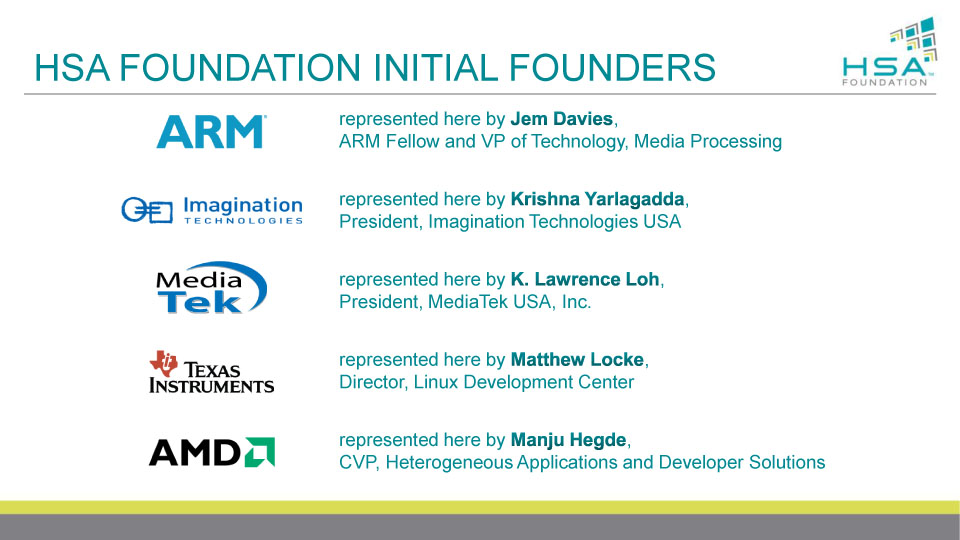
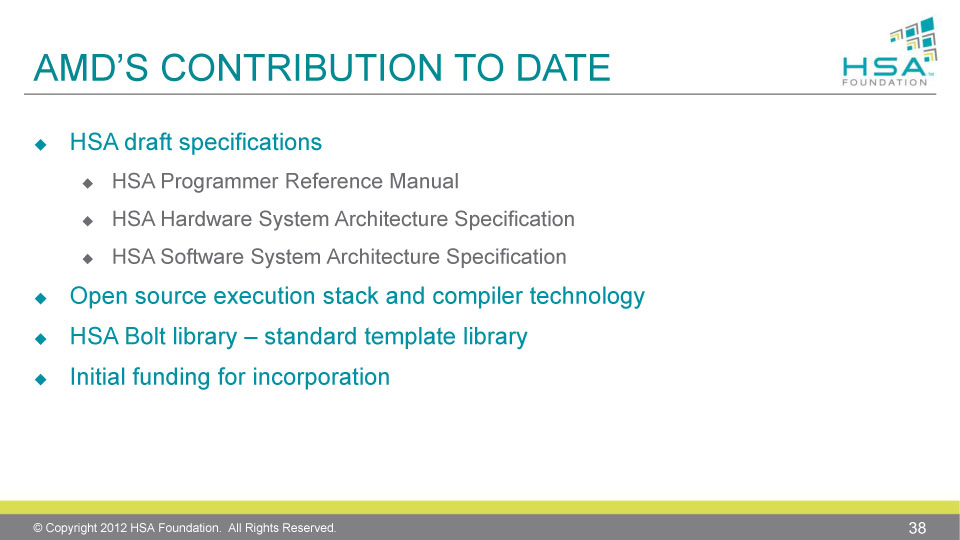
AMD, ARM, MediaTek, Imagination and Texas Instruments Founded HSA Foundation


Many of our readers heard about HSA and probably already found out about the AMD-funded HSA Foundation, but not that many really know what it is all about and what the main differences from Nvidia or Intel’s approach are.

The news unveiled at AMD’s AFDS 2012 event was that it, along with Imagination Technologies, ARM, MediaTek and Texas Instruments have founded the Heterogeneous System Architecture Foundation with initial funding from AMD. The main goal of the foundation is to work on, develop and standardize all future HSA technologies. Currently, there are two main directions for a software developer to head on when attempting to achieve the highest performance for its program. The first direction is x86 or generally CPU programming and optimization, may that be x86, RISC, ARM, MIPS or any other CPU architecture.

There are millions of programmers that know how to work and optimize for general purpose processing architectures like x86 or ARM. One other direction for the software developer is GPU compute programming and parallelization, but only specific tasks can take advantage and achieve greatly increased performance if they are specially optimized for GPU compute. On the other hand, the software developer must keep in mind that he must invest in GPU compute programmers or to specialize his own team on the concept. Then, he must weigh the performance increase predictions against the cost of the GPU compute extra programming work and the investments in hiring programmers that know how to do it.

AMD’s HSA vision consists in a special programing tool library that will effectively create a layer between the programmer and the hardware. Practically the software programmer will write and code programs just like he used to or use very small modifications and simple optimizations, but the HSA layer will know how to best execute the code to take advantage of the hardware. They are not saying that there won’t be any GPU compute work to do, but AMD is emphasizing on the fact that there is a much smaller effort involved in programming using the HSA method for HSA hardware than doing device specific coding like CUDA.

There is much sense in AMD’s initiative, as Intel practically agrees with them by also emphasizing that coding and porting for its Xeon Phi GPU compute architecture requires much less effort and investment than optimizing for CUDA. Having huge and influential companies like Texas Instruments and ARM backing the initiative can only reassure AMD that HSA is going to make a serious impact on the industry.


Heterogeneous System Architecture - HSA Foundation
Images credits to AMD

Corsair 8GB VengeanceLP DDR3-1600 Memory Kit Modules


Well-known memory modules manufacturer Corsair, also known for its high-quality power supply units and SSDs is already shipping its new VengeanceLP 8 GB DDR3 DIMMS. The modules work at a standard 1600 MHz frequency and feature cool, black aluminum heatspreaders.

Had you been expecting anything out of the ordinary about these new modules, you’re in for a disappointment. As reported by Overclockers.ua The default latencies are 10, 10, 10, 27 and the default voltage is 1.5V. Corsair says that its new 8GB VengeanceLP DDR3-1600 memory modules come with complete support for Intel’s XMP and are backed by a lifetime warranty.

The pricing is slated at a high $71, and the official release date is the 14th of July, 2012. For about €78, the European buyers will get simple LP DDR3-1600 DIMMs with a full warranty from Corsair.

Corsair VengeanceLP DIMM
Image credits to overclockers.ua

iPhone 5 “ES” Leaked


Photos of an “iPhone 5 engineering sample” corroborate all rumors about the next-generation smartphone from Apple, including a taller body, changes to the hardware on the back and the sides, and more. The antenna placement seems to be identical as well.

GottaBeMobile got hold of these images from “a trusted source inside the Apple supply chain.” This metal iPhone 5 design sample can be regarded as a type mold which acts as a good indicator of the height, width, and other design aspects. The iPhone 5 appears to retain the outer-frame antenna design introduced in 2010 with the iPhone 4, and perpetuated by the iPhone 4S. Hopefully, Apple won’t run into any more trouble in this department, as the company will also have to worry about battery life, and other elements that can be considered crucial to the end-user’s experience with such an expensive device. The camera placement seems to be unchanged, though the back camera lens cutout appears to be a tad larger than the one found on the iPhone 4S.

The mold also shows a rear-facing microphone placed between the camera and LED flash. This mic is believed to be used for both video recording and noise cancellation to improve sound quality for footage shot with the device, as well as phone calls. The iPhone 5 is taller for a reason – that being the (rumored) larger, four-inch display. There has been some speculation as to whether developers will run into trouble trying to scale up their apps to fit the wider screen. Some say it’s not as hard as non-programmer minds think, whereas others are convinced it will pose development issues for those who have a well-established user base with 3.5-inch screens (current-generation iPhone and iPod touch).

Purported engineering sample of Apple (iPhone 5) next-generation smartphone (front)
Image credits to gottabemobile.com

Purported engineering sample of Apple (iPhone 5) next-generation smartphone (back)
Image credits to gottabemobile.com

Android ICS 4.0.4 Alpha 4 Build Available for Nokia N9


Nokia has just started to push the PR 1.3 update to its Nokia N9 users, yet those who would like to try something new have the option to get Android 4.0.4 up and running on their smartphones.

Android 4.0.4_r2.1 (ICS) for Nokia N9 is now available courtesy of people behind NITDroid, and has reached version Alpha 4, it seems. The new build is based on Android Open-Source Project (AOSP) v 4.0.4_r2.1 (IMM76L), and can be installed only on Nokia N9 devices that are currently running PR 1.3. For those out of the loop, we should note that the software does not require for users to completely remove MeeGo from their smartphones. In fact, it has been designed so as to offer dual-boot capabilities, enabling users to choose the OS to boot into after power up. Moreover, the Android 4.0.4 on Nokia N9 will provide users with access to application through the Google Play store, as well as with specific software coming from Google themselves (the Google Apps).

Not all things are working as they should at the moment – after all, this is still an alpha release – but most of them do, and users should receive a more than acceptable experience from their devices if they choose to install the new build. 3D drivers, OpenGL, hwrotation, touchscreen (multitouch) hw buttons (volume, power), ECI accessory (headset buttons), USB networking, sleep mode, alarm driver, basic video decoding (sw) and playback, WiFi (only basic functionality), Bluetooth and wireless connectivity are working at the moment. Users will also see working battery status, charging indication, sensors: accelerometer, compass, audio, and root access, along with a fakeGPS functionality (ability to trick system and set any location as GPS fix). The new release also comes with a series of fixes from the previous Alpha 3 build. Those who would like to learn more on Android for Nokia N9 or give it a try should head over to this forum post on NITDroid.

Nokia N9
Image credits to Nokia

Intel Itanium Processor Manual Reveals 9500 Poulson Models


Last time we talked about the Itanium processors, it was, thankfully, to provide some info on the chips themselves, and their codename, instead of updating people on the lawsuit they are involved in.

Ever since Oracle said it was dropping development of Itanium processor software, HP and Intel have been holding the opposite line. HP outright sued Oracle while Intel assured the world, repeatedly, that Itanium chips would keep being refined and released for at least ten more years. The effects have been mixed. Oracle has had to suffer serious backlash (and court losses), but HP's Itanium servers started selling less and less. Meanwhile, even Intel encountered some issues in its development and manufacture of the Poulson, the upcoming Itanium 9500 series. And by issues, we mean that, even though Intel didn't officially say anything, word came out that the next-generation Itaniums had been delayed (they were supposed to launch last month, July 2012). They will now launch in the third quarter (July-September).

Fortunately, that does not mean we have no new information to provide. Indeed, though the launch was moved back, Intel finished the Reference Manual for the processor 9500 SeriesAlso known as the Software Development and Optimization Guide, it contains specs and the names of four SKUs (stock-keeping units). In order of capability, they are 9520, 9540, 9550 and 9560. All Poulson Itanium are 8-core chips with 16 KB instruction on each core and 16 KB data first-level cache memory. The full cache capacity can go as high as 32 MB, of which some is divided into 512 KB instruction and 256 KB data mid-level caches. That said, the clock speeds are as follows: 1.73 GHz for the 9520, 2.13 GHz for the 9540, 2.4 GHz for the 9550 and 2.53 GHz for the 9560. As for the rest, Itanium Poulson benefit from 4 full-width and 2 half-width Quick Path Interconnect links, dual-channel DDR3 RAM support, Hyper-threading and Virtualization. The manufacturing process is 32nm.

Intel logo
Image credits to Intel

Cintiq 24” Painter’s Tablet


We remember Panasonic’s and DRS Tactical Systems’ rugged tablets for professional use, but what Wacom had in mind with its Cintiq tablets series is something totally different.

Targeted for professional artistic use, the Cintiq 24HDtouch features a high-quality 1920 by 1200 pixel resolution screen. As most of you already figured, the Cintiq 24HD uses a 16:10 display format that’s currently almost unavailable on the market.

Five or six years ago, 16:10 displays were touted as the true high-definition and featured the 1920 x 1200 resolution, but then display manufactures decided to skip on quality and charge the same amount of money for 16:9 1920 x 1080 screens that are cheaper to make and feature the same diagonal size. A 1920 by 1200 screen with a 16:10 format offers you more working space and a less distorted point of view, as professionals like painters and architects are always bothered by 16:9 screens.

Twitter Delicious Facebook Digg Stumbleupon Favorites More

 
Design by Free WordPress Themes | Bloggerized by Lasantha - Premium Blogger Themes | coupon codes
`