JustForex
Loading recent posts...

Jul 18, 2012

Micron PCM (Phase Change Memory) for Mobile Devices


Micron announced today the availability of the world’s first mobile phase change memory in a dual-chip/multi-chip package for mobile devices. There is a lot to say about PCM memory, but the shortest definition is that it is a flash memory replacement with very high write speeds and great durability.

Like we just said, phase change memory (PCM) is a direct competitor to flash storage technology, but it can also act like a RAM chip. There was a lot of research done in this field and slowly, but surely, companies involved in PCM research gave up on using it as a RAM alternative and concentrated on building a viable storage alternative. The two main advantages PCM has over NAND is the fact that write speeds are greatly increased, while the endurance is many times higher. Most SSDs using 25nm NAND have a rated durability of 3,000 or 5,000 program/erase (P/E) cycles, which translates in a lifetime of 5 to 10 years of daily usage. A storage device using PCM technology is rated at more than 100,000 P/E cycles, thus making it at least 20 times more durable than today’s NAND, and durability is currently the most pressing issue in SSD industry.

PCM technology and any kind of memristor that uses the phase change concept is based on the amorphous and crystalline states of chalcogenide. The amorphous state is a high-resistance state where the material doesn’t allow the current to pass signaling a binary “0” and the crystalline state is a low-resistance state signaling a binary “1.” The technology is times slower than today’s SRAM, but it is many times faster than NAND when writing, while the read speed is competitive. Add the increased durability and you have a strong NAND flash technological competitor. If PCM will manage to successfully compete against NAND on price it still remains to be seen. Instead of launching a high-capacity PCM device like Samsung’s 8 Gb PCM chip in 20nm technology launched last year, Micron is offering a multi-chip package containing 1 Gb for software and operating system storage and 512 Mbit LPDDR2 high-speed memory.

Micron PCM Marketing Shot
Image credits to Micron

Windows Phone 8 to Pack Mass Storage Features


One of the great new features that Windows Phone 8 might bring along is rumored to be support for mass storage.

Through this capability, users will be able to connect their handset to their PC without the need to install the Zune software to be able to access files on the mobile phones. Other smartphone operating systems already feature the capability, enabling users to easily move files back and forth between phones and computers. According to WPDang, Windows Phone 8 will come with this feature as well, in addition to offering support for removable microSD memory cards.

This might also change users’ ability to install applications coming from unofficial sources, rumor has it. However, with Microsoft promising over-the-air updates for Windows Phone 8, the need for Zune is much lower, and the manner in which devices connect to PCs might indeed be changed.


Windows Phone 8
Images credits to Microsoft

Raspbian OS for Raspberry Pi


We've written about the raspberry Pi with pretty much every occasion we got, so we're obviously not going to skip on such a relevant occurrence as the appearance of a new OS for it.

Based on the Debian, the Raspbian operating system is optimized specifically for the $35 / €28.60 device. The main asset is the faster web browsing, courtesy of improved floating point operation processing, but the applications, kernel and firmware will be upgraded as well.

Go here to see where and how to download the file (it is an SD card image, to make everything nice and easy). Other operating systems are available as well, based on a Linux core. If you don't have one of the Raspberry Pi credit card-sized PCs yet, you can finally get as many as you want.

Raspberry Pi
Image credits to Raspberry Pi Foundation

Office 2013 Features To Arrive on Windows Phone 8


On Monday, Microsoft unveiled to the world its brand new Office 2013 productivity suite, set to become commercially available sometime in the beginning of the next year.

The application brings along a brand new user interface, along with various features based on cloud connectivity, and new social capabilities. Designed for use on desktop PCs, as well as on tablets running under the new Windows 8 platform, the application will arrive on Windows Phone 8 handsets as well, though in a completely different form. In a recent blog post explaining some of the main cloud features of Office 2013, Microsoft also noted that some of these capabilities would be delivered to Windows Phones as well. One thing that is certain at the moment is that Office 2013 will be connected across devices, so that users could easily access documents wherever they might go.

For example, Word and PowerPoint will remember where you were with reading a document, and will enable you to return exactly to that page. This feature will be available on all devices where one user has Office installed, including handsets that are powered by Windows Phone 8. “For example, Word and PowerPoint make it easy to get right back into your work by remembering where you left off in each document or presentation,” John Jendrezak, group program manager in Office, explains. “So, if you didn’t have time to finish reviewing an important document before you had to leave work, Word will remember what paragraph you were last reading/editing when you open that document on another machine.”

John Jendrezak also notes that “these features extend to your mobile device as well. For example, your Windows Phone will show your recent files for one-touch access while you are on the go.” Microsoft did not offer further details on what office will include on Windows Phone 8 devices, and even used a Windows Phone 7.5 handset to demo some of the features in the new application, WMPoweruser reports. Chances are that existing users will get a taste of these enhancements as well on their smartphones as soon as Windows Phone 7.8 arrives, though this is only a supposition for the time being.

Office 2013 on Windows Phone
Image credits to WMPowerUser

ColorFire Eyefinity XStorm Radeon HD 7850 Pro X6 Video Card


We met ColorFire’s first cards here and here and we were quite impressed with Colorful’s new brand. Today, the company has yet another high-quality product that features AMD’s Eyefinity technology in its most complete implementation.

The new card is called Colorfire XStorm 7850 X6 Eyefinity Pro and is based on AMD’s Radeon HD 7850 design. Radeon HD 7850 is AMD’s product name for the 800 Mhz version of the “Pitcairn” GPU. Pitcairn comes with 1,280 shaders and 80 texture units all using GDDR 5 memory running at 4800 MHZ effective speed. ColorFire has decided to outfit its new card with six mini DisplayPort connectors that can connect to HDMI, DVI or D-SUB slots using the proper adapters, as Overclockers.ua report.

The card features 2 GB of GDDR5 memory and the GPU is slightly overclocked to 860 MHz. The 92mm fan cools a heatsink containing two copper heatpipes. The whole thing is priced around $300, which is about €246 for the European multi display enthusiast.


Colorfire XStorm AMD Radeon 7850 X6 Eyefinity Pro
Images credits to overclockers.ua

AMD Piledriver FX Quad Core Processors


As we’ve just reported here, AMD is rushing to clean up after the Bulldozer mess and most processors based on this architecture will EOL in December 2012. The Bulldozer based FX models will be replaced with Vishera parts based on the enhanced Piledriver architecture.

We’ve already reported here about the 8-core FX 8350 Piledriver processor and we’ve confirmed it here, but now it’s time for our readers to meet AMD’s new quad core lineup. The new processors are FX 4300, FX 4320 and FX 4350. The former will be the slower quad core Vishera part at launch and will work at 3800 MHz and the Turbo boost will be able to clock it at a full 4 GHz. It comes with a total 8 MB of cache  and sports a 95 watts TDP. The middle quad core Vishera brother is the FX 4230 that is clocked at 4 GHz but will reach 4200 Mhz when Turbo is applied and sports the same amount of cache like the FX 4300 and the same TDP. The fastest Vishera quad core processor launched this winter will be AMD’s FX 4350 and this CPU will reach 4300 MHz on Turbo although the default frequency is “only” 4.2 GHz, as Fudzilla report.

AMD’s FX 4350 will come with a 50% larger total cache when compared with the rest of the 4300 line. Featuring 12 MB total cache, the FX 4350 will not consume more than the 95 watts just like the rest of the 4300 brothers. It’s quite ironic that AMD is the company that frequently launches CPUs faster than 4000 MHz despite the fact that Intel was the one bragging about its low performance “10 GHz” Pentium 4 architecture for more than 7 years, if we take into consideration the 1999 Pentium 4 hype.

AMD's FX 8150 Processor
Image credits to bit-tech.net

Jul 17, 2012

Nvidia GeForce GTS 650 is Only 3% Faster than GTS 550 Ti


Nvidia’s new Kepler architecture has proven to be quite a success among gamers and this is owed to the fact that the GPU is very efficient, relatively cool and overclockable, next to the impressive performance it brings.

During the initial launch, many mid- and low-end cards based on the new architecture were announced, but not so many managed to reach users, as Nvidia is first waiting to clear the old Fermi-based stock. Slowly but surely, the Kepler GPUs are replacing the Fermi architecture in the company’s lineup and now GeForce GTS 550 Ti’s replacement is close to launch, as VideoCardz report. This card that will replace the popular GTS 550 Ti is called GeForce GTS 650 and is powered by the GK107 Kepler GPU. Compared with the GTS 640 we already know, Nvidia’s GTS 650 comes with the same number of 384 CUDA cores and 128-bit memory interface, but it will likely be clocked at 1 GHz or more.

The memory is GDDR 5 with a likely effective data rate of 4800 GHz instead of the DDR3 used on the GT 640. The maximum power consumption is rated at about 70 watts, which means that reference cards will not feature the extra power connector that GTS 550 Ti has. Compared with the 192 pipelines that the GF116-based GTS 550 Ti has, Nvidia’s GTS 650 will only be about 3% faster while consuming considerably less energy than the 116 watts the GF116 is sucking. There is not much info on the benchmark result, but the guys that managed to test the card confirm that the performance difference is almost nonexistent.


Nvidia Low-end comparison
Images credits to vga.it168

Team Group UHS-1 Xtreem Series Memory Cards


We don't know when, where and for how much money you'll be able to buy one of Team Group’s newest memory cards, but we do know everything else worth knowing.

Called SDHC UHS-1/Micro SDXC UHS-1, they are made for tablets, phones and driving recorders. As suggested by the UHS-1 specification, the transfer speeds are significant: up to 40 MB/s reading, 10 MB/s writing. Speaking of which, random read IOPS are of up to 500, while writing is done at 150.

Furthermore, the data retention is of over 10 years and the power source of 3.3v. All in all, the newcomers are about three times better at writing than products of the same class, or at least three times faster at scribing bits. Real-time communication apps and boot loading of portable gadgets should exhibit the sharpest time differences.

Team Group UHS-1 memory cards
Image credits to TechPowerUp

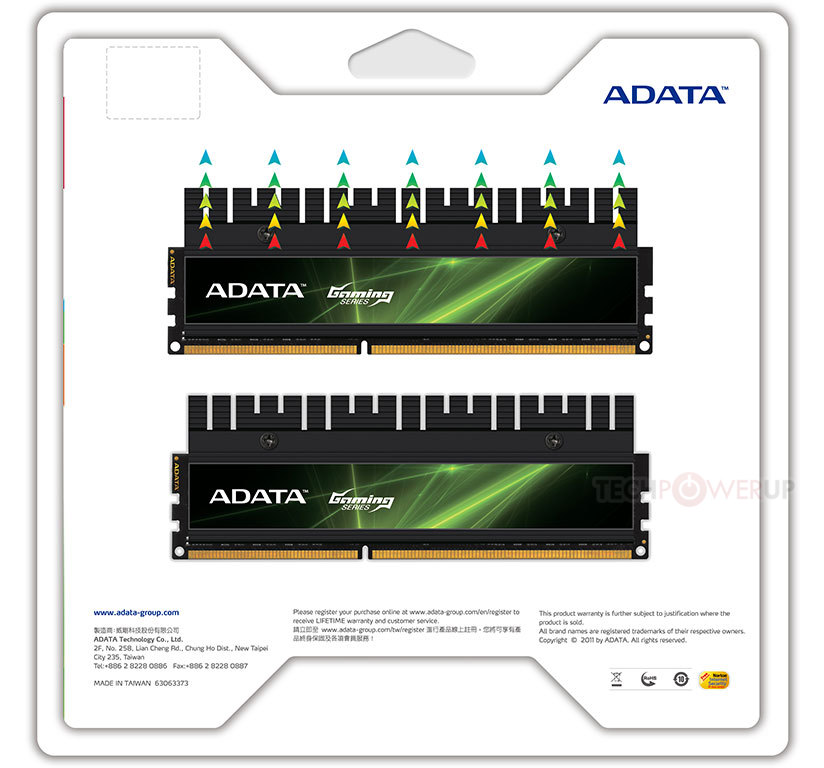
ADATA XPG Gaming v2.0 Series DDR3 2400G Memory


ADATA is probably in a good mood after its results of last month, and there aren't many better ways for such an IT corporation to celebrate a job well done than a new and mighty piece of hardware.

We say ADATA is likely in good spirits due to recent findings that suggest it has good product shipments and high revenues in June 2012. The company is working hard to ensure the third quarter is at least as productive, although this newest product might not help as much as one would think. We aren't implying that there is anything wrong with it, far from it, but high-end hardware tends to not reel in many users, due to its price. Still, the XPG Gaming v2.0 Series DDR3 2400G DRAM modules will serve just fine as enhancers of the company's prestige.

For those who don't know, XPG stands for Xtreme Performance Gear. It is a brand with a similar role to ASUS' ROG. The maximum frequency is, obviously, 2400 MHz / Mbps, while the bandwidth can go as high as 19200 MB/s. Also, the modules, with their capacities of 4 GB, have XMP certification (Intel Extreme Memory Profile) and the Thermal Conductive Technology (TCT). Whatever heat isn't dissipated by the 2oz copper 8-layer printed circuit board, the heatspreaders take care of (they have a screw-lock mechanism that boosts cooling efficiency for long-term use).

Finally, ADATA managed to squeeze a latency of CL10-12-12-31. Latencies are always less impressive on modules with high frequencies but this setting is actually more than decent. The product page of the ADATA XPG Gaming v2.0 Series DDR3 2400G DRAM modules is right here. If you live in the US or Canada and own a Z77 motherboard and a third-generation CPU, you might want to consider paying the $89.99 / €73.23 price.


ADATA XPG Gaming v2.0 Series DDR3 2400G
Images credits to ADATA

CyanogenMod 10 Preview Builds Available for Samsung Galaxy S III


As soon as Google announced the availability of Android 4.1 Jelly Bean, the CyanogenMod team promised the availability of CM10 based on the new platform release.

CM is one of the most popular custom software for Android devices out there, and many are already eagerly waiting to get it on their units. For some Galaxy S III users, the wait is over, though with a caveat. Only preview builds of CM10 can be downloaded at the moment, and they are buggy.

However, things have started to move in the right direction, and more stable builds are expected to become available in the not too distant future. In the meantime, those who would like to grab the early software release should head over to this thread on XDA-Developers for the SGH-I747 (LTE) downloads, and to this thread for the T999 bits.

Samsung Galaxy S III
Image credits to Samsung

Twitter Delicious Facebook Digg Stumbleupon Favorites More

 
Design by Free WordPress Themes | Bloggerized by Lasantha - Premium Blogger Themes | coupon codes
`