JustForex
Loading recent posts...

Mar 21, 2012

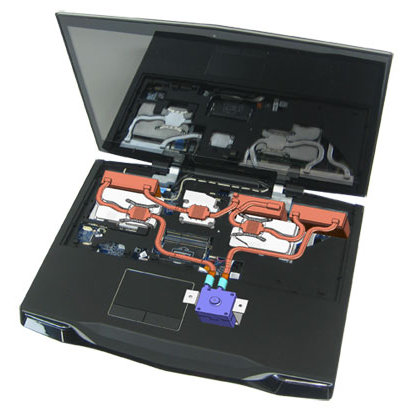
Asetek Demos Liquid Cooled Alienware M18x Notebook, Video Included


Asetek, a company well known for its maintenance-free liquid cooling solutions, showcased a new technology that allows such cooling systems to be used inside gaming notebooks, workstation-grade laptops and AIOs.

The liquid cooling system was demonstrated inside an Alienware M18x notebook and it comprises three compact radiators, three waterblocks and a water pump.

The latter is placed right under the palm rest area, while the three waterblocks are used to cool the two Radeon HD 6990M GPUs installed inside the M18x and the notebook’s Core i7-2920XM CPU.

To showcase the power of its liquid cooling system, Asetek overclocked both the CPU and the GPUs installed in the notebook.

In the case of the Core i7 processor, this had its frequency increased from 3.5Ghz to 4.4GHz, while the Radeon HD 7990M graphics cards had their operating clocks raised from 680MHz to 800MHz.

According to Asetek, this enabled the M18x to reach a 23 percent higher 3D Mark Vantage score, while also reducing the noise output of the stock air-cooled laptop. 

“We see a growing need for higher performance personal computers, driven by ever more powerful modeling software for engineering, scientific and financial work, and for content creation and gaming,” said AndrĂ© S. Eriksen, founder and CEO of Asetek

“We also see high performance hardware expanding to more portable, sleeker devices like the highly successful M-series of notebooks from Alienware.

“For laptops and AIOs to deliver workstation and gaming PC performance, these machines must be able to take full advantage of desktop grade performance hardware. We have identified this need and designed our cooling solution to target these thinner machines,” concluded the company’s rep.

If you want to learn more about Asetek’s new liquid cooling technology, or see it in action, make sure to check out the video bellow.


Ceramic White GALAXY S II WiMAX Coming to Japan via KDDI


The WiMAX version of the Galaxy S II was launched in Japan in mid-January, but customers could only choose the black color variant. 

However, starting on March 24, those who still wish to grab the smartphone will be able to get it in white as well. 

The folks at SammyHub have just learned that the ceramic white Galaxy S II WiMAX will be available for purchase at KDDI this weekend.

There are no differences whatsoever between the two color versions, but customers may want to check the smartphone’s regional availability at the carrier’s site.

Just like the black-themed variant, the ceramic white Samsung Galaxy S II WiMax will be shipped with Android 2.3 Gingerbread on board. 

Still, the South Korean handset maker promised all Galaxy S II models will be upgraded to Android 4.0 Ice Cream Sandwich by the end of the year.

In fact, Samsung has already started to push the update for unlocked Galaxy S II devices, but carrier-bounded units, like KDDI’s Galaxy S II WiMAX, will get it later.

Unlike the original Galaxy S II, the WiMAX version comes with a slightly larger 4.7-inch Super AMOLED capacitive touchscreen display that supports HD (720 x 1280 pixels) resolution and features Corning Gorilla Glass coating.

The smartphone also packs a more powerful processor in comparison with the original model, which features a 1.2 GHz dual-core CPU. The WiMAX model, which will soon go live at KDDI, is equipped with a dual-core processor clocked at 1.4 GHz.

Furthermore, Galaxy S II WiMAX boasts an 8-megapixel rear photo snapper on the back, which features LED flash, autofocus and full HD (1080p) video recording, as well as a secondary 2-megapixel camera for video calls.

It also comes with 16GB of internal memory, 1GB of RAM, microSD card slot for memory expansion (up to 32GB), and NFC (Near Field Communications) support.


White Galaxy S II WiMAX Japan regional availability

iPad Developers Can Easily Port Apps to Windows 8, Microsoft Shows


This fall, the world will get a full taste of the next generation operating system from Microsoft, Windows 8, as well as of the applications designed specifically for it. 

Over the past several months, the Redmond-based software giant has been providing developers with details on what they need to do to have applications up and running on Windows 8, and is not delivering more of these. 

Among them, we can also count info on how app builders would be capable to port their applications from Apple’s iPad to tablet PCs running under the upcoming OS. 

In fact, the company has published a case study on its website to demonstrate how iPad developers could take advantage of Windows 8’s capabilities to enhance their applications while porting them to the new platform. 

Applications that target Windows 8 specifically need to be built based on the new Metro UI principles that Microsoft has introduced last year when unveiling the platform. These applications will be distributed through Microsoft’s new application portal, the Windows Store.

“In this case study we want to help designers and developers who are familiar with iOS to reimagine their apps using Metro style design principles,” the company notes on its website

“We show you how to translate common user interface and experience patterns found in iPad apps to Windows 8 Metro style apps. 

“We draw on our experience building the same app for the iPad and for Windows 8. We use common design and development scenarios to show how to leverage the Windows 8 platform and incorporate Metro style design principles.”

The case study brings to the spotlight a connected photo journal that provides users with the possibility to easily view and manage their photos and videos online. The app also offers a timeline view.

After building the application for the iPad, the team at Microsoft started porting it to Windows 8. On the company’s website, they show how each component of the iPad application can be translated into Metro style design.

Developers interested in getting started with the building of applications for the next gen platform from Microsoft can now download the Windows 8 Consumer Preview Build 8250, available on this page.


Nvidia GeForce GTX 680 Price Reportedly Set at $499 (375 EUR)


Rumored for quite some time to be released at a $549 price point, Nvidia’s upcoming GeForce GTX 680 graphics card based on the company’s Kepler architecture is now said to be priced at $499 (about 375 EUR).

According to Fudzilla, Nvidia’s add-in board (AIB) partners have received the new price earlier this morning.

No reason for this alleged price cut was given, but this makes the GTX 680 a much better deal than before, especially considering the leaked benchmarks to show up so far, that place its performance over that of the AMD Radeon HD 7970.

Despite the new $499 price tag received by the company’s AIBs, the card’s official "Recommended Retail Price" or European price still hasn’t been provided by Nvidia, so things could still change in this regard.

The GK104 graphics core the GTX 680 is said to be based upon packs 1536 stream processors, and a 256-bit wide memory bus that is connected to 2GB of video buffer.

Nvidia has apparently clocked the VRAM at an impressive 1,500MHz (6GHz data rate), while the base GPU frequency is set at 1,006MHz.

As we previously revealed, Nvidia’s next-generation Kepler graphics core will also feature support for a new technology called Dynamic Clock Adjustment.

Apparently, this works similarly to Intel’s Turbo Boost technology to automatically increase the graphics core frequency to a maximum of 1058MHz, when the video card works below its rated TDP.

Speaking of TDP, the GTX 680 is expected to fit inside a 195 Watt thermal envelope, and gets its power from two 6-pin PCI Express connectors that are stacked one on top of the other at the rear of the PCB.

As far as the video output configuration is concerned, the GTX 680 will come equipped with a pair of dual-link DVI ports, an HDMI port, as well as with a DisplayPort 1.2 connector. The GeForce GTX 680 is expected to be made official on March 22.


30 Indonesian Women Settled Madagascar


Despite its proximity to Africa, the original continent for our species, the large island of Madagascar was not settled until about 1,200 years ago, making it one of the last natural bastions to be conquered by humans. New studies show a group of just 30 Indonesian women populated this land. 

Scientists have always wondered about why this island displays such rich biodiversity, and why such unusual animals populate it. The answer appears to be very simple – evolution was allowed to follow its natural course here without human interference, LiveScience reports.

Experts from the Massey University believe that a vessel carrying a small group of Indonesian women – as few as 30 – capsized near Madagascar. The survivors were the ones who populated this land, which might explain how an entire culture was trans-located across the entire Indian Ocean. 

Of the original group, experts calculated that 28 were Indonesian and two were African. These precise numbers were extracted from analyses conducted on the mitochondrial DNA of 300 native Madagascans and 3,000 Indonesians.


Photo of MetroPCS’ Optimus M+ Emerges


US wireless carrier MetroPCS is expected to release a successor for the LG Optimus M smartphone that arrived on shelves last year. 

Said to appear as the LG Optimus M+, this device will deliver a wide range of improvements, though it will retain the affordable price tag. 

MetroPCS’ LG Optimus M+ should pack a 3.5-inch touchscreen display when released, which is the first noticeable change from the original device. Last year’s smartphone packed a 3.2-inch, 64,000-color HVGA display. 

However, it appears that the new device keeps the same resolution for its screen, though it increases the number of supported colors to 256,000. 

Additionally, the leaked specifications list for this device unveils the fact that it will arrive on shelves with an 800MHz application processor inside. 

Another improvement will be spotted when it comes to the mobile phone’s photo snapper, which is a 5-megapixel camera on Optimus M+ (compared to the 3.2MP camera packed with its predecessor). Not to mention that the new phone also features flash. 

According to a recent article on Pocketnow, which also brought to the web leaked photos with this mobile phone, LG also packed Bluetooth 3.0 EDR inside Optimus M+ as an improvement over the predecessor’s Bluetooth 2.0 capabilities. 

The new smartphone is powered by Google’s Android 2.3 Gingerbread operating system – there are no details available on whether it will receive an upgrade to the newer Ice Cream Sandwich platform but, based on its specs, we can presume that it won’t.

LG Optimus M+ features model number MS695 and should arrive on shelves at MetroPCS in the near future, although no specific info on the matter has been officially unveiled for the time being. 

Until more on this new Android mobile phone for MetroPCS emerges, have a look at the photo attached to this article to get an idea of what it would look like.


Script: stopcensorship.js


stopcensorship.js was born after the recent massive protests against bills like SOPA, PIPA or ACTA. The library is a protester's best friend, visually previewing a future in which the Internet is controlled by corporations and not the content creators.

When including stopcensorship.js on a web page, using a complex algorithm, the library chooses random words which it censors by adding a black strip/box over them.

As you can see from our screenshot above, random words are scratched out. Every time the user reloads the page, other words are censored.

At the top of the page a small bar is shown, with a button that can remove the censorship bands and allow users access to the page. Also a link to the Stop American Censorship campaign (default) is included. This link can be edited to point to your own protest campaign's website.

The library's download package also contains a PHP file which can be used as a WordPress plugin for embedding the library on WP-powered sites.

Here's a demo of stopcensorship.js in action. Bugfixes and issue requests are handled via its GitHub account.

Download stopcensorship.js from our Scripts section here.


The iPad 3 Has WiFi Problems Now


Heat isn't the only thing new iPad adopters are complaining about. The new-generation of tablets appears to be having some WiFi issues too.

Buyers of the new Apple iPad are growing a thread on Apple Support Communities with complaints about the tablet’s wireless capabilities.

One user says “I am in a hotel with my laptop and new ipad3. The laptop wifi reception is as strong as it gets, but the iPad only registers a weak signal. Anyone else having similar problems? Any suggestions?”

Another chimes in to say “I am seeing this too. I am currently writing this from mymipad 1 because my new iPad RIGHT BESIDE ME doesn't pick up my wifi signal….”

“Same here ipad2 has twice the wifi range with the same settings as the ipad3. The screens nice but I may return mine if this is the way they all are,” says another.

Forum user “stlsteve” actually had high hopes for the tablet. He picked up the new iPad from Best Buy, as he prepared to go on his honey moon in Hawaii.

He had imagined he’d catch up on some news reading once he’d arrive, but no cigar:

“I picked mine up at Best Buy on Friday on my way to the airport for our honeymoon in Hawaii (Kauai). What a disappointment it has turned out to be. Pictured myself reading the news with it each morning over long, relaxed breakfasts and coffee and in a lounge chair by the pool. Instead, I am sitting in a baautiful restaruant typing this with my big awkward laptop. The iPad goes back to Best Buy when I get home,” he writes.

Apple may address the WiFi connection issues, and the alleged overheating of the tablet device, in a future software update. It has also been reported that the tablet doesn't charge while running some games. For now, all these remain to be confirmed as widespread issues.


Area Reveals VGA-to-TV Converter


Today's HDTVs can usually connect to PCs just fine, but that's only because they have HDMI or other PC-compatible ports.

Regular TVs, those that only have composite or S-Video inputs, or other common plug, can't do the same, even if they are otherwise suited for such a task.

Area decided to do something about this, leading to the making of the SD-DSCV.

Basically, this is a VGA down-scan converter device, in other words an adapter that turns VGA output into legacy/TV-compatible signals, with outputs to match.

Of course, sacrifices had to be made: the maximum resolution is of 1,024 x 768 pixels.

In addition to the video ports, the Area SD-DSCV has an USB cable, which draws power from that interface.

April 9 is when sales will start, in Japan at least, for the price of 4,980 JPY (US $59.4 / 44.751 Euro).


Green House Releases PicoDrive Micro Flash Drives


If you're living in Japan and happen to own an ultrabook, you might want to take a look at the new USB 2.0 flash drives that Green House put together.

Called the PicoDrive Micro line, they are said to be convenient for owners of such mobile PCs because they are very small and light themselves.

More precisely, they measure 22.6 x 14.9 x 8.5 mm (0.88 x 0.58 x 0.33 inches) and weigh 3.1 grams.

When plugged in, they only stick out about 9mm from the port, which makes them nearly invisible and, thus, negligible.

The storage capacities available to choose from are 4 GB, 8 GB and 16 GB, while the prices are of 1,480 JPY ($17.7 / 13.30 Euro), 2,980 JPY ($35.6 / 26.78 Euro), and 4,980 JPY ($59.5 / 44.75 Euro), respectively.


Twitter Delicious Facebook Digg Stumbleupon Favorites More

 
Design by Free WordPress Themes | Bloggerized by Lasantha - Premium Blogger Themes | coupon codes
`